LONDRES CAPITALE DE L'ANGLETERRE
£175
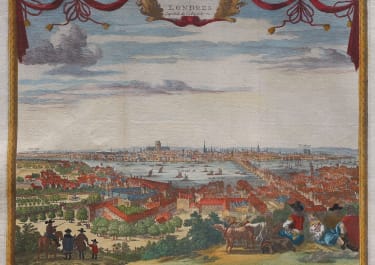
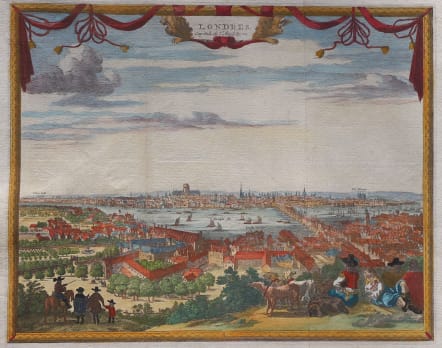
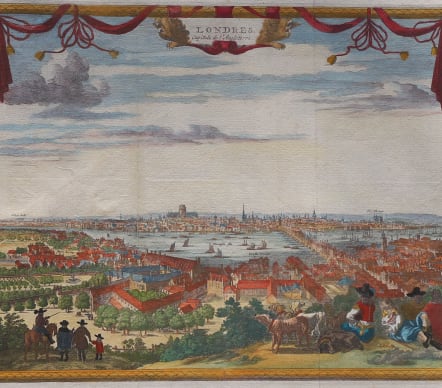
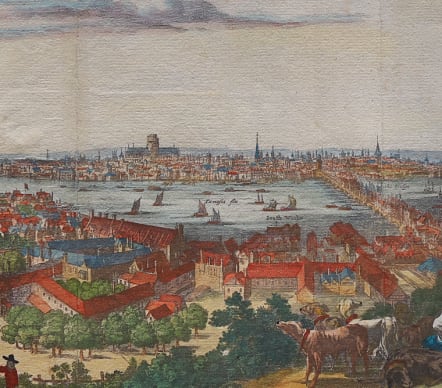
Londres, Capitale de l'Angleterre by Pieter van der AA is an interesting representation of London, published in 1720. From an imagined vantage point atop a nonexistent hill in Southwark, the viewer gazes northwards, observing the city with the casual passersby and dogs populating the foreground.
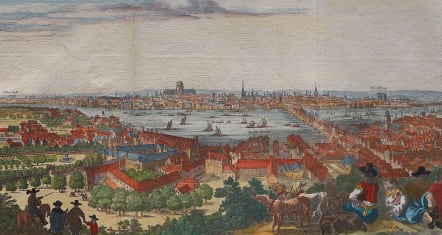
The artist owes inspiration to Hollar's "Long View," particularly regarding the architectural rendering of the buildings along the south bank of the River Thames.
Of particular interest in this pre-Great Fire of London view are the houses located on London Bridge, and the old St. Paul's Cathedral, which had already lost its steeple due to a lightning strike. The representation of these historical landmarks provides an invaluable glimpse into the architectural landscape of pre-fire London.
Adding to the charm of the piece is the decorative frame border, which is enhanced by swagged ribbons.
On the left, we see "White Hall," and on the right, a notable misspelling designates "The Thower" - referring to the iconic Tower of London. The prominence of London Bridge in the illustration underscores its significance in the city's infrastructure and daily life. This art piece serves as an essential cultural artifact, capturing the aesthetic and historical essence of London.
Folds as issued
Slight repair on rear
Excellent hand colour
Good condition for this scarce view
References: Van der Krogt 4 - #2436
The view was published in van der Aa's La Galerie Agréable du Monde. Rare publication
code : M5581
Cartographer : Van Der AA
Date : 1720 Amsterdam
Size : 22*27 cms sheet size 29*36 cms
availability : Available
Price : £175
Pieter Van Der Aa (1659-1733)
Van Der Aa was a prolific publisher, working in Leiden during the first three decades of the eighteenth century. Much of his output consisted of re-issues and re-engravings of map and view plates that he had acquired from earlier mapmakers. Little of his output was original, though that which is has a very distinct style, precisely and elegantly engraved, and is much sought-after today.
Perhaps his most remarkable publication was the elaborate Galerie Agreable Du Monde, issued in 1729, in 66 parts, bound into 27 volumes, which contained about 3,000 plates, apparently limited to 100 sets. Another of his extensive publications was the Cartes Des Itineraires Et Voyages Modernes, a collection of 28 volumes of travel accounts, illustrated with a series of small, but finely engraved maps, often with decorative pictorial title-pieces.
An interesting feature of Van Der Aa's method is that several of his atlases include maps printed within large, separately engraved, elaborately designed mock-frame borders, which were prepared with a blank centre so that individual maps could be over-printed on that area.
Despite the quantity and variety of Van Der Aa's publications they seem to have had only a limited circulation, and so are now scarce.