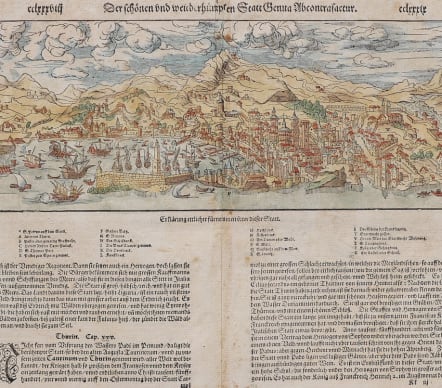
GENOA STATT GENUA
Sold
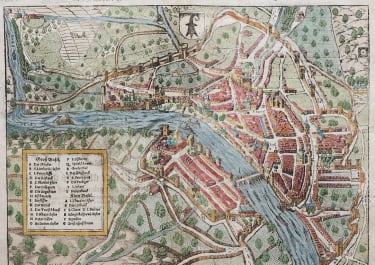
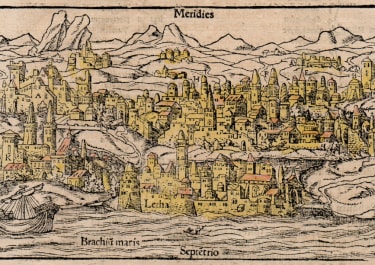
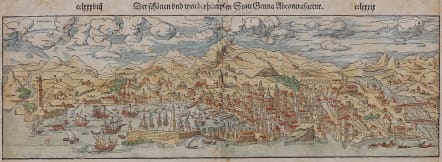
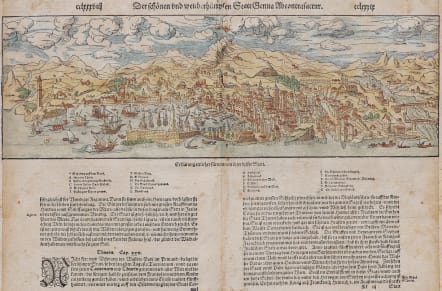
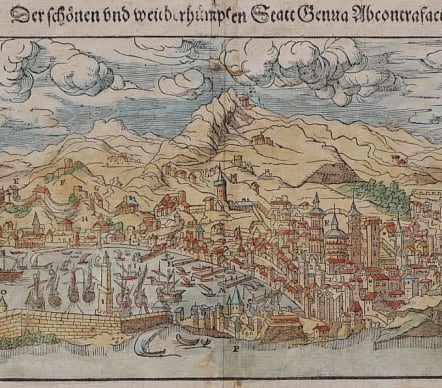
Early plan of Genoa with good hand colour.
Attractive birdseye view of Genoa from the harbor, showing numerous buildings, ships, the surrounding mountains, etc. A key below the view identifies 24 building and places on the map. From the a 1570 edition of Munster's Cosmography, one of the most influential geographical works of the 16th Century, first published in 1544.
As in virtually all examples of this view it is cropped short on the sides ( plate too big for paper) and here margins have been added for framing.
Good hand colour
Good / Fair condition.
Was £250 SALE PRICE £125
code : M5171
Cartographer : Sebastian Munster
Date : 1550 Basel
Size : 14*41cms
availability : Sold
Price : Sold
Originally a scholar studying Hebrew, Greek and mathematics, Sebastian Munster (1489-1552) eventually specialised in mathematical geography and cartography. It was this double ability - as a classicist and mathematician - that was to prove invaluable when Munster set himself to preparing new editions of Solinus’ “Memorabilia” and Mela’s “De Situ Orbis”, two classical descriptive geographies containing maps, and his own two greatest works, the “Geographia” and “Cosmographia”. These reflect the widespread interest in classical texts, which were being rediscovered in the fifteenth century, and being disseminated in the later fifteenth and sixteenth century, through the new medium of printing.
The “Geographia” was a translation of Ptolemy’s landmark geographical text, compiled in about 150 AD., illustrated with maps based on Ptolemy’s calculations, but also, in recognition of the increased geographical awareness, contains a section of modern maps. In the first edition of the “Geographia”, Munster included 27 ancient Ptolemaic maps and 21 modern maps, printed from woodblocks. Subsequent editions of the “Cosmographia” were to contain a vast number of maps and plans.
One consequence of Munster’s work was the impetus it gave to regional mapping of Germany, but Munster was also the first cartographer to produce a set of maps of the four continents on separate maps. Most importantly, through his books (the “Geographia” and “Cosmographia” alone ran to over forty editions in six languages), Munster was responsible for diffusing the most up-to-date geographical information throughout Europe.